
Wednesday evening walking past the Sikh place as the sun set on my way to the White Hotel, I wondered if I’d still have cause to come round these parts once the venue finally closed its doors. I had been taught the Sikh meditative practice of Simran recently at the Whitworth. But as my previous experience with Sikhism had gotten me roped in to an impromptu sword display on Oxford Road, where I was told to keep my thumb in if I didn’t want to lose it, I’m still on the fence.
If you’ve never been to the White Hotel it’s on the site of an old garage and still looks like that from the outside, vehicles in various states of disrepair on either side of the approaching road behind a fenced off parking area holding a dishevelled trailer.
The setting confused some who travelled here for the weekend of noise that was the excellent Negative Output recently, leading to an arduous and aimless reconnaissance for at least one connection I made that weekend. On my way in this evening they let me know about the venue continuing as Bastion but we’ll see what comes of that.
It was more FOMO that brought me here for APTBS but having listened to a few of their albums recently it felt like the right move. And from the promoter there was the promise of overwhelming volume and transcendent sound and lights, which is my sort of thing.
A bright young German woman was good-naturerdly trying to sort some minor issue at the door as I came in. When die Anstalt came on stage (introduced by a recording of Oliver Ackermann misspronouncing their name to the amusement of his bandmates) I realised she was the vocalist. The lighting in the White Hotel is so good it makes me think it’s impossible for an act not to look cool here but still, their confident brand of “synth punk” performed in their own language had me thinking of the fictional industrial nightclubs in VHS era action movies.
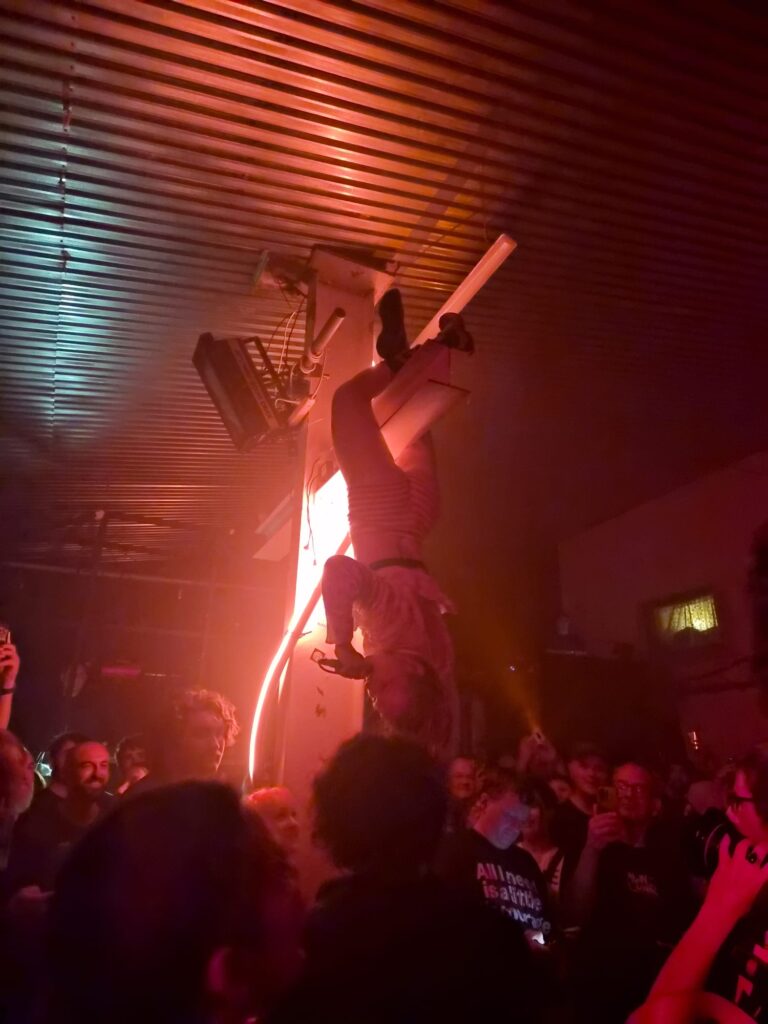
They don’t have a drummer, but Carmen Redeker definitely makes up for that missing kinetic component, clambering on top of speakers and at one point suspended upside down from the central crucifix-like roof support. The lighting cable coiled around its steel sections blasted her stomach with orange-red hues like the sunset outside as she maintained her barked vocal intensity.
Having made the mistake of going to the bar between acts, helping a would-be pianist attribute his failure to muster a coherent tune to mechanical failures in the white upright rather than his inebriation, the venue had filled out considerably for the headliners. I involuntarily found myself in the middle of a story about an uber from hell back from The Cure’s performance at Wythenshawe Park last weekend, worrying that we’d have a static, lifeless crowd given how rammed it was.
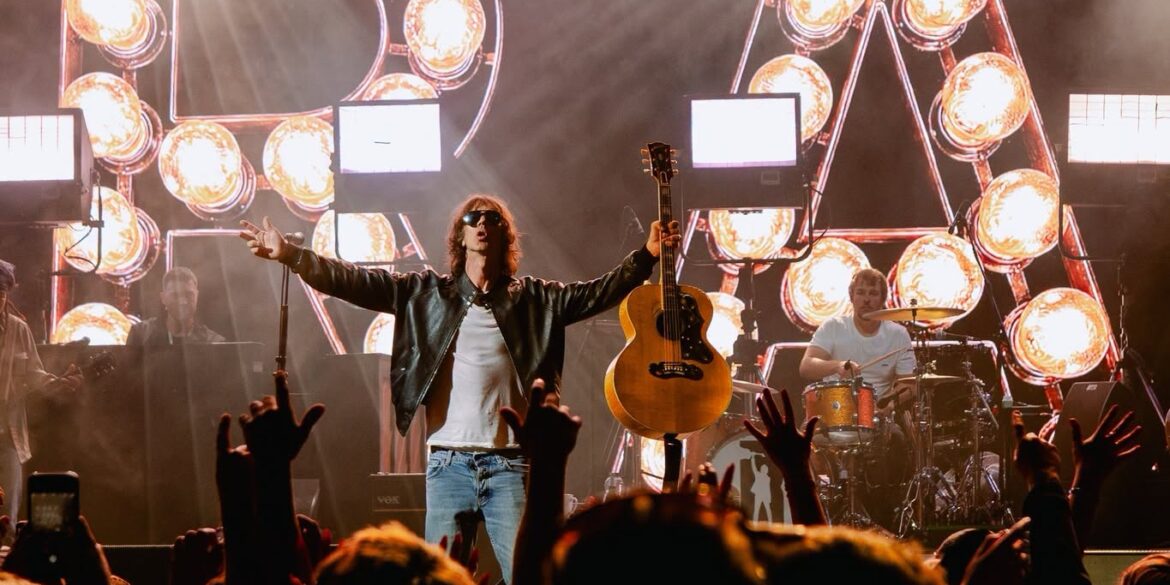
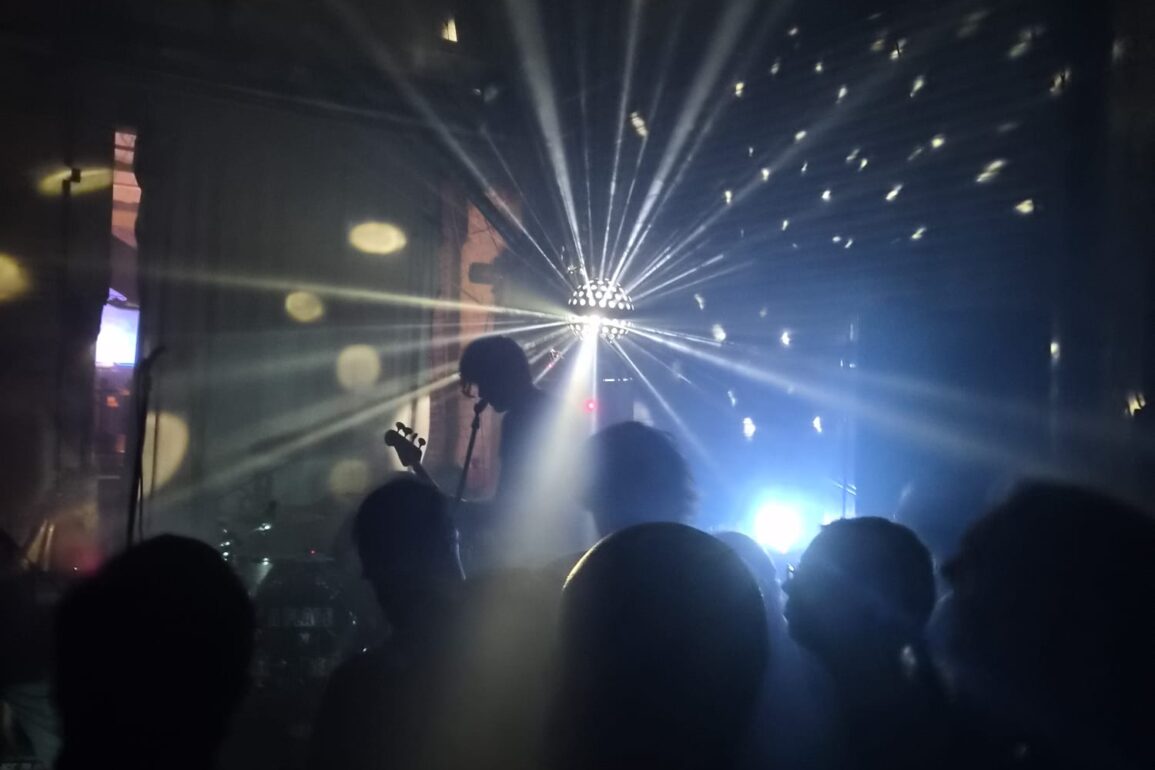
The worry was wasted energy, as the wild, continual crescendo of the headliners was soon matched by movement from the front. Love to see it. The unbridled renditions of their songs teetered on the edge of chaos as a maelstrom of lights assaulted the senses. Oliver’s guitar was offered to the audience before being repeatedly slung around his shoulder. Its dance matching the wailing, whirling dirge that consumed the space.

Sandra Fedowitz’s pounding on the drums was only visible to me to begin with as a shadow cast on a far wall by the constantly cycling colours of the visuals. She then held a large tom aloft, presaging a yet more primal phase of the evening with a brutal insistence as she took centre stage. The paired-back percussion gave rise to a tribal intensity, which only continued as first Oliver forced his way through the crowd, wheeling in a tray of effects that glitched and crushed his voice into acidic echoes. He was then joined by the rest of the band, forming a tight circle; the crowd surrounding them in a trance-like fervour. Hearing the skin of the tom reverberate close up and the steel scratching of John Fedowitz’s bass strings as Oliver worked a bewildering array of pots and switches illuminated by alternating LEDs was bafflingly incongruent with the unrelenting volume. It was a yet wider sonic spectrum, and it was almost disappointing for me when the band eventually returned to the stage.
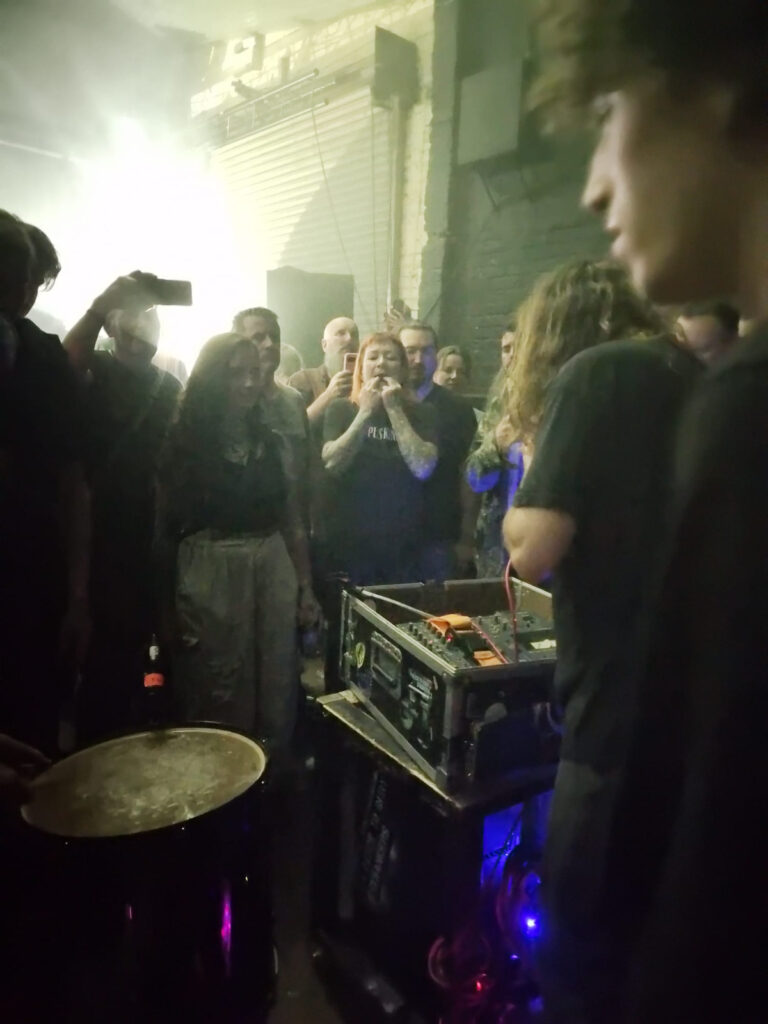
I think that disappointment coloured my feelings for the latter part of the set. Having seen Walls of Teesside the previous Saturday, where the audience actively took part in the performance, I maybe subconsciously wondered what energies could come from a larger crowd. I cannot fault the energy and commitment of the band though, Oliver at one point covering his face with a metal sheet, amplified and effect driven. An encore would’ve been preposterous and absolutely no-one felt short-changed once the band finally left the stage.
It seemed strange for the crowd to just carry on their separate ways having shared that experience. Although talking to a fellow gig-goer on my way back into town, who’d not worn hearing protection, maybe conversation was just too difficult?