
Kierkegaard wrote, “Repetition is and remains a transcendence” – Repetition (1843). Repetition is often mistaken for movement without progress, repeating the same point and returning to the point of origin. But what did Kierkegaard mean by repetition remains a transcendence? Instead of repetition being a cycle, a continuous loop, returning to its origin, it could be viewed as a vortex, each cycle altering after each repeat. The action of repetition may remain the same, but the same cannot be said for our consciousness.
Repetition and transcendence have been exercised in music throughout history with the likes of Steve Reich’s ‘Music for 18 Musicians’, La Monte Young’s ‘The Well Tuned Piano’, Warp Records’ Seefeel ‘Quique’, and distinctly present on Shit and Shine’s 2025 ‘Mannheim Hbf’. Each album uses cycles – sometimes rhythmic – to create a mesmeric charm of introspective clarity through an altered state of consciousness.
Alongside Reich, Young, Seefeel and S&S, the motorik momentum of the post-war Krautrock movement adopted repetition as a form of transcendence and futurism. In more recent years, the European trance and techno styles have obtained repetitious hooks as a vital element for transcendence. Clubs have provided an oasis of escapism by allowing people to temporarily remove themselves from their everyday lives to enjoy a sense of community and freedom. As to repeat is to confront time. Hence why nightclubs are licensed until the early hours, and sometimes 24 hours. Repetition reveals the impossibility of returning, and, in doing so, becomes a way of moving beyond.
Look at The Dreamachine by British Canadian inventor Brion Gysin. Gysin invented the Dreamachine from a single flickering light inside an incessantly rotating case that could induce altered states of consciousness, aiming to explore and expand the relationship between art and the mind. Gysin believed it would eclipse television as a medium for experiencing visual stimuli and consciousness.
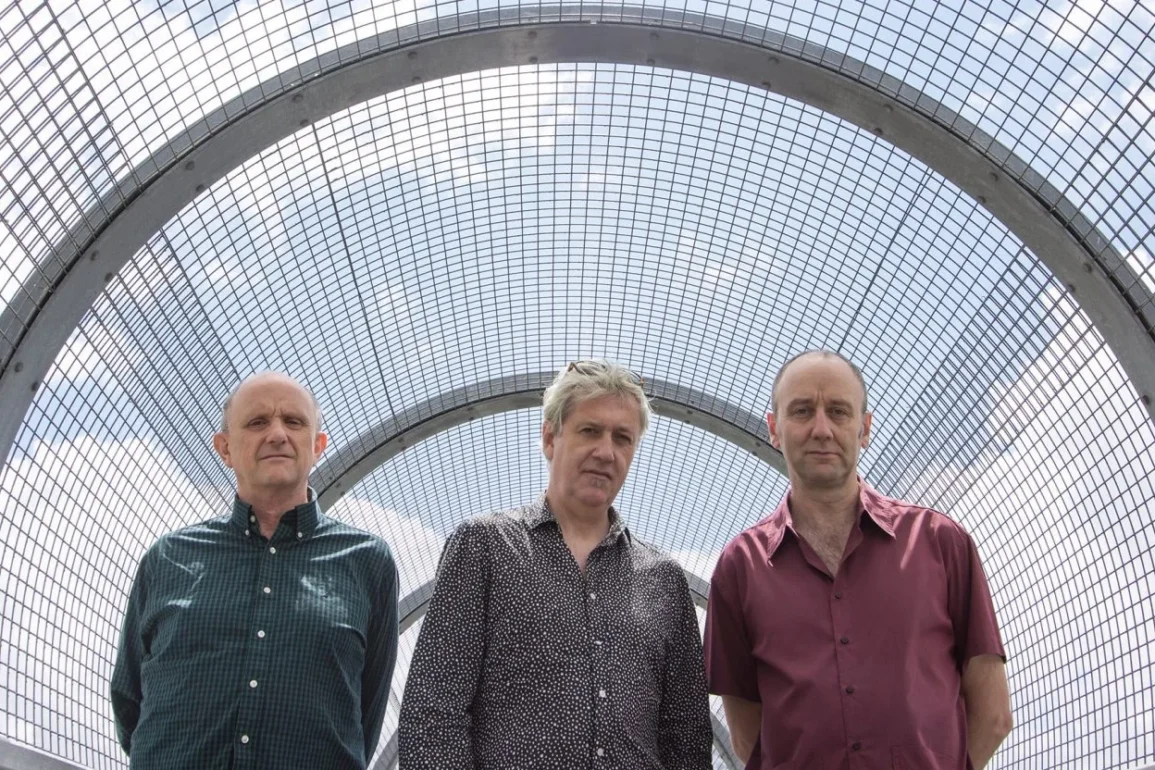
At Stoller Hall in Manchester, The Necks exemplify a perfect balance between improvisation and repetition by conducting a courageous two-and-a-half-hour set of unfiltered, evolving excursions. With only two compositions in their set, the Australian trio challenge any offerings of traditional song structures, removing any reference points of time and asking the listeners to allow the music to slowly unfold.
As the trio, composed of pianist Chris Abrahams, bassist Lloyd Swanton and percussionist Tony Buck, walk onto the stage, they stand in silence, absent from the few hundred on-lookers, to devise a shared silence, until natural sounds are released from their instruments. An organic, slow fluttering, free-form drift is tackled, while the sounds appear independent, leaving each member to carefully guide and control.
Percussive scratches arise, while Chris Abraham wanders gently along the keys, unveiling The Neck’s signature world, as each member effortlessly contributes, showcasing their expertise in delicate meanderings.
Within perpetual, dynamic-shifting ebb and flow, the crowd become captivated, some with their eyes shut, and some fixated on the band, in any attempt to study the technicalities and improvisational forms.
Unable to recollect entirely what happened next, a warm, composed state of transcendence glowed – topics and thoughts emerge without warning or control. The Necks operate on a higher offering, with angelic-like perspectives akin to those featured in Wim Wenders ‘Wings of Desire ‘. Humanity is viewed from the outside by angels that have knowledge without experience. The audience is held, though not by force, by want and intrigue, stunned at the lucid offerings devised by the trio. Feelings I’d tucked in the bedroom drawer for later now suddenly feel unavoidable, laid bare to confront.
As the percussion scratches continue, and the bass, now played with a bow, intensifies, the band concoct a unison, aligning the free-formalities into a tight-knit, rhythmic pulse before the edifice crescendos. A familiarity warms a comfort, and we arrive at where we began – a recollection, a memory, of a time that once was. Where did we go? How long has it been? Well, one hour to be precise. Questions appear like flies, as the shore moves closer and percussive chimes remind us of the unpredictable turbulence of life, the veracity, the volume, the dynamics, the peaks and troughs, and the pure essence of spontaneity. We can learn a lot from experiences like these. We can learn a lot from experiences like these. We can learn a lot from experiences like these.