
I’d argue there are very few albums that have escaped the confines of simply being records and instead become cultural landmarks. They are the albums that define generations, soundtrack formative years, and somehow continue to find new audiences long after the fashions surrounding them have disappeared. The Black Parade is unquestionably one of those records. Released in 2006, My Chemical Romance’s rock opera about death, memory and acceptance became far more than another successful emo album. It became an identity for millions of people who found pieces of themselves hidden within its grand theatricality, and its refusal to apologise for feeling absolutely everything.
Nearly twenty years later, those songs still carry extraordinary weight.
That perhaps explains why the band’s three sold-out nights at Wembley Stadium felt less like a reunion tour and more like a pilgrimage. Fans travelled from across the country and far beyond, many dressed in marching jackets, black eyeliner and Killjoy colours that paid tribute to every era of the band’s career. Some had grown up alongside these songs, while others were discovering them years after the band’s original peak, with the band becoming quite the phenomenon on TikTok. Different generations stood shoulder to shoulder beneath the arch, united by music that has somehow refused to age.
I was lucky enough to attend the last night of the extraordinary performances on the 11th of July, and even before a note had been played, there was a feeling that this was going to be something far greater than a stadium concert.
Wembley has an atmosphere unlike almost anywhere else. The long approach from the station gradually reveals the stadium in stages, the famous arch growing larger with every step until it dominates the skyline entirely. Around it, thousands upon thousands of black-clad fans flooded Olympic Way, merchandise bags swinging by their sides while snippets of conversations drifted through the crowds. People debated dream setlists, swapped stories from previous tours and compared homemade jackets covered in hand-painted lyrics and album artwork. It felt less like arriving at a gig and more like entering a convention dedicated to one band’s legacy.
There was excitement, certainly.
But there was also gratitude.
For many people around me, this wasn’t simply another date on a tour schedule. It was a chance to finally witness a band they had waited years to see, or perhaps to relive a part of their youth that had remained surprisingly untouched by time. Every queue seemed filled with stories. One group excitedly discussed seeing My Chemical Romance during the Three Cheers for Sweet Revenge era, while another admitted this would be their first ever concert. Somehow, both conversations felt equally valid.
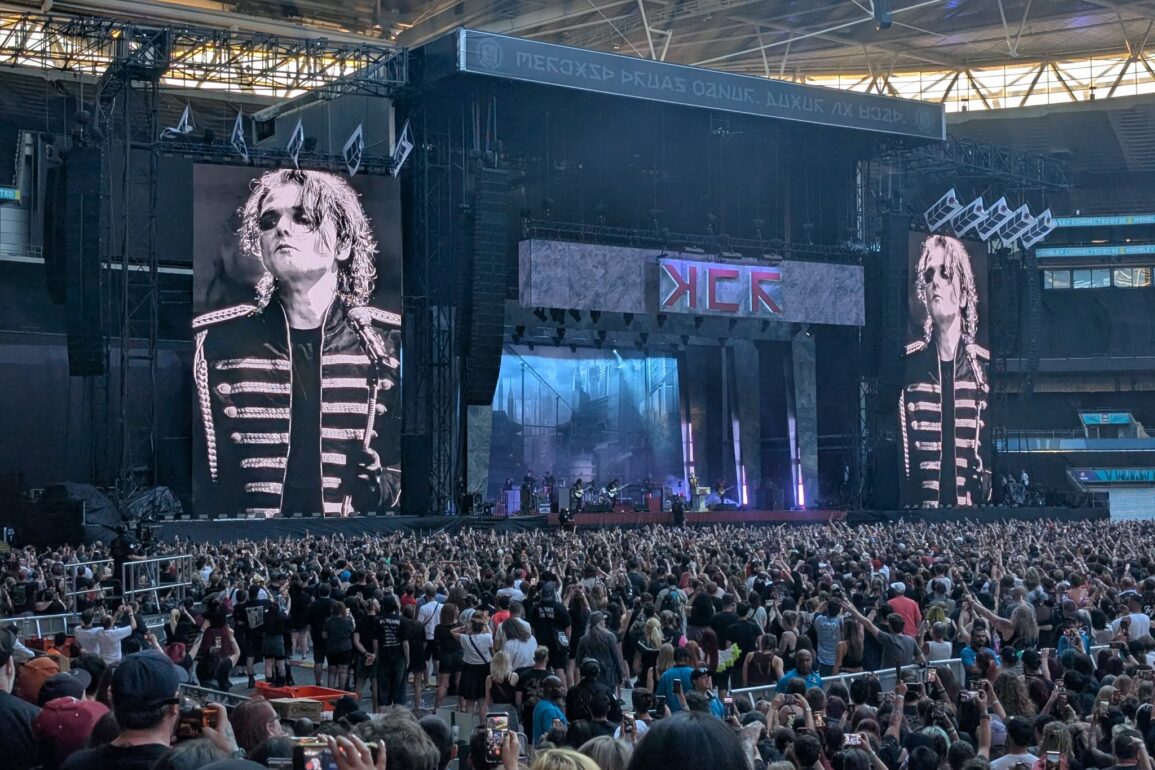
Inside, Wembley looked spectacular.
The enormous main stage dominated one end of the stadium, its towering backdrop hinting that this would be no ordinary rock production. Every inch of it suggested theatre rather than convention. Massive structures framed the performance space, while hidden details invited speculation about exactly what My Chemical Romance had planned. Even empty, the stage seemed to possess its own personality.
Elsewhere, a second stage sat much further into the stadium floor, initially overlooked by many as people found their places. It would become enormously important later in the evening, although at the time its purpose remained something of a mystery.
As the stadium gradually filled, Anthony Green quietly took to the stage.
For anyone familiar with post-hardcore, Green hardly needs introduction. As the unmistakable voice behind Circa Survive and more recently L.S. Dunes, he has spent decades building a reputation as one of alternative music’s most distinctive vocalists. His solo work, however, occupies a much gentler space, more intimate, more introspective and considerably less immediate than the bands for which many people know him.
Unfortunately, that intimacy proved difficult to translate inside a stadium still only partially occupied.
Large numbers of fans were still making their way through Wembley as his set began. Long queues continued to form at food vendors, merchandise stands remained packed, and streams of people kept appearing through the entrances, searching for their seats. Looking around, it became clear that Anthony Green was performing to a noticeably sparse audience, particularly across the upper tiers.
That is never an easy position for any artist.
To his credit, he approached it with complete professionalism.
His voice, as always, carried a fragile beauty that somehow managed to sound both delicate and powerful. Songs unfolded gently across the vast space, accompanied by understated instrumentation that prioritised atmosphere over immediacy. There was something undeniably sincere about the performance.
Personally, though, it never fully connected.
That had far less to do with Anthony Green himself than simple familiarity. While I know and admire his work with L.S. Dunes, I came into this set with very little knowledge of his solo catalogue. Without that emotional connection to the material, much of it drifted past pleasantly rather than leaving any lasting impression.
It also suffered slightly from the realities of stadium scheduling.
Music this personal naturally invites careful listening, yet around the concourses conversations continued, people filtered constantly through the aisles, and the sense of anticipation for what lay ahead inevitably overshadowed everything occurring onstage. Anthony Green deserved more attention than circumstances ultimately allowed him.
Still, he provided a thoughtful opening to the evening.
Rather than attempting to overwhelm an audience already eager for the headline act, he quietly eased Wembley into the night, offering something reflective before the emotional intensity that would follow.
If Anthony Green gently opened the evening, Sunny Day Real Estate raised its emotional temperature considerably.
Seeing them appear on a Wembley Stadium stage felt quietly surreal.
Their influence on alternative music cannot really be overstated. Long before emo became a commercial phenomenon, Sunny Day Real Estate had already helped define much of its emotional vocabulary. Countless bands, My Chemical Romance included, owe something to the groundwork they laid during the 1990s. To witness them supporting one of the genre’s biggest success stories carried a pleasing sense of history coming full circle (pun fully intended).
Unlike Anthony Green’s intimate songwriting, Sunny Day Real Estate immediately filled the enormous stadium with richer textures and more muscular arrangements.
Jeremy Enigk’s unmistakable voice still possessed that extraordinary balance between vulnerability and urgency, soaring effortlessly above the band’s shimmering guitars. Time has done remarkably little to diminish their chemistry. Every song felt completely lived in, performed with the quiet confidence of musicians who have never needed spectacle to command attention.
For me, one song towered above everything else.
“In Circles”.
The opening notes alone were enough to send a ripple of recognition through sections of the crowd that knew exactly what was coming. Hearing that song echo around Wembley was genuinely special. Its mixture of melancholy and release remains as emotionally affecting today as it was decades ago, and for a few precious minutes, the stadium seemed to shrink dramatically.
It was, without question, the highlight of their performance.
At the same time, I could not completely shake the feeling that I had seen them in an environment that suited them better.
The last time I watched Sunny Day Real Estate perform, it was inside a festival tent.
There, surrounded by darkness and relatively close walls, their music felt almost enveloping. Every quiet moment landed with greater intimacy, every crescendo seemed to rebound immediately from the canvas overhead. Their songs thrive in enclosed spaces where every subtle shift in dynamics can fully breathe.
A stadium inevitably asks different questions of a band.
No matter how accomplished the performance, there is only so much atmosphere delicate music can generate while disappearing into open summer air. Wembley demanded scale, and while Sunny Day Real Estate undoubtedly sounded excellent, their greatest strengths felt slightly diluted by the sheer enormity of the venue.
None of that reflected poorly on the band themselves.
If anything, it highlighted just how uncompromising they remain.
They did not attempt to alter their identity in pursuit of easy festival moments. There were no forced singalongs, no exaggerated attempts to command attention from an audience unfamiliar with their work. Instead, they simply played their songs with conviction and trusted that those who understood would appreciate them.
Many clearly did.
Unfortunately, many others simply did not know who they were.
Throughout the set, people continued filtering into the stadium in significant numbers. Drinks were still being purchased, photographs were still being taken, and conversations carried on throughout sections of the seating. Around me, several people admitted they had never heard Sunny Day Real Estate before, while others appeared content simply waiting for My Chemical Romance without fully engaging with what was happening onstage.
It felt like a missed opportunity.
Not because the audience behaved badly, but because one of the most influential bands in alternative rock history deserved to perform before a crowd fully aware of their significance.
Perhaps that is simply the nature of support slots at stadium shows.
They are often caught between two realities. Dedicated fans understand exactly what they are witnessing, while much of the wider audience sees them merely as something to fill the time before the main event. Sunny Day Real Estate deserved better than that, but they delivered a superb performance regardless.
As they left the stage, applause rolled warmly around Wembley.
It was appreciative, if not quite as rapturous as the music merited.
Then the real anticipation began.
Every passing minute seemed to heighten the atmosphere another degree. Conversations grew louder before gradually falling away altogether as the stadium filled for the first time that evening.
Looking around, it was impossible not to pause for a moment.
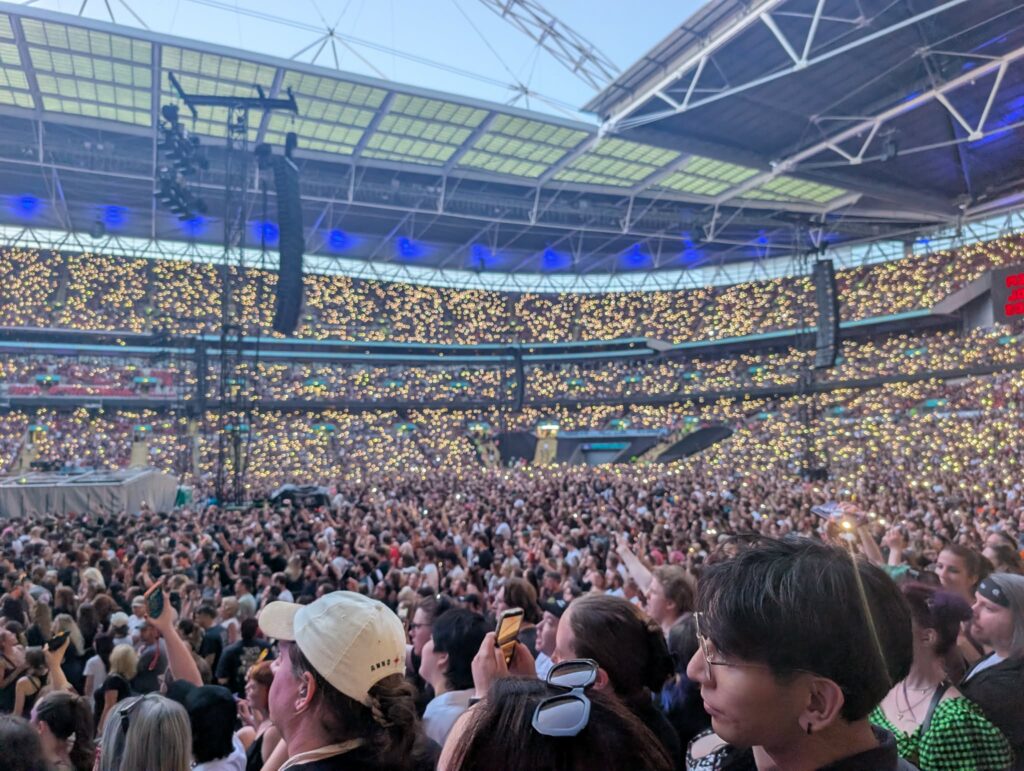
More than ninety thousand people stood together beneath the Wembley arch, every seat occupied, every section alive with expectation. The sea of black clothing stretched endlessly into the distance, punctuated by flashes of parade jackets, Killjoy masks and homemade banners celebrating albums that had helped shape countless lives.
There are few sights in live music quite like a sold-out Wembley Stadium waiting for a band that genuinely means something to its audience.
If the atmosphere before My Chemical Romance took to the stage had been one of excitement, the moment the lights finally disappeared transformed it into something much deeper. Ninety thousand voices became one deafening roar as Wembley was swallowed by darkness, anticipation hanging in the air so thickly it almost felt tangible. For a band whose relationship with theatricality has always sat at the very heart of their identity, simply walking onto a stage was never going to be enough.
Instead, they told a story.
Jane Driver-Loach – My Chemical Romance
The evening opened not with the band themselves, but with Vera Lynn’s “We’ll Meet Again”, its familiar wartime optimism drifting across Wembley as thousands instinctively began singing along. It was an inspired choice, nostalgic yet quietly unsettling, immediately setting a tone that felt less like the beginning of a concert and more like the opening scene of a play.
The effect was extraordinary.
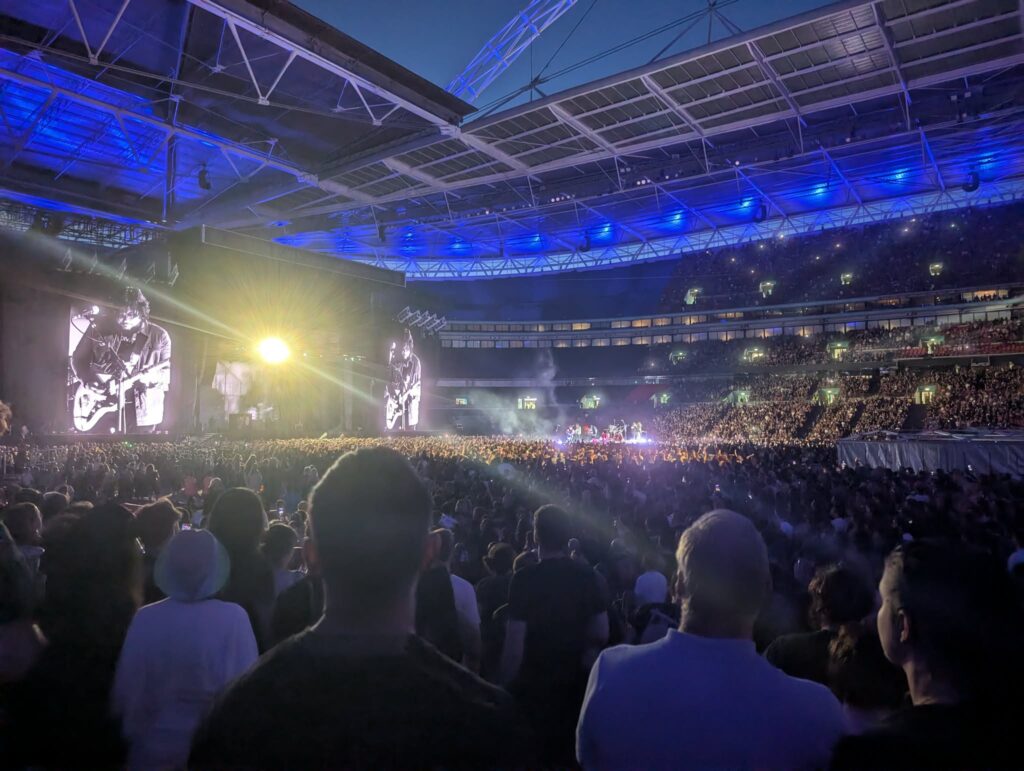
From the very first moments, it became clear that this was not simply The Black Parade performed from beginning to end. This was My Chemical Romance fully embracing the album’s identity as a rock opera, expanding its mythology into something that blurred the lines between theatre, live music and performance art. The staging, the costumes, the interludes and the carefully choreographed movements all worked together to create something that felt meticulously designed rather than merely spectacular.
Then, without warning, “The End.” arrived.
Gerard Way emerged to an eruption unlike anything heard all evening up to that point, leading the band into the album’s haunting opening with remarkable precision. Hearing those opening words inside Wembley Stadium felt almost surreal. So many people had imagined this moment for years, perhaps decades, and suddenly it was unfolding exactly as they had hoped.
The transition into “Dead!” was explosive.
Any lingering restraint instantly vanished as the band tore through one of the record’s most energetic moments with astonishing intensity. Frank Iero and Ray Toro immediately reminded everyone why they remain one of modern rock’s most formidable guitar pairings, their interplay effortlessly balancing melody and aggression while Mikey Way’s unmistakable basslines anchored everything beneath them. Behind it all, Jarrod Alexander drove the songs forward with relentless energy, every drum fill landing with absolute precision.
What struck me almost immediately was just how exceptional Gerard Way sounded.
There has always been an emotional rawness to his voice, an imperfection that somehow makes every lyric feel more believable. Live, however, there was a confidence that elevated everything another level. Whether snarling through the heavier passages or allowing quieter moments to breathe naturally, he seemed completely in command of every note.
It was one of the strongest vocal performances I have ever heard from him.
As “This Is How I Disappear” and “The Sharpest Lives” followed, the production surrounding the band continued revealing itself piece by piece. Actors drifted across the stage embodying characters from the ever-expanding Black Parade narrative, elaborate props appeared and disappeared almost unnoticed, while enormous video screens seamlessly blended live footage with theatrical imagery. Every transition felt deliberate. Nothing appeared accidental.
It would have been easy for a production of this scale to overshadow the music.
Instead, it enhanced it.
Every visual flourish served the songs rather than distracting from them, deepening the emotional weight of an album already overflowing with imagery and symbolism. My Chemical Romance have always understood that The Black Parade is more than simply a collection of songs. It is a world, and for two hours Wembley became completely immersed within it.
Then came the moment everyone had been waiting for.
Few songs in alternative music history command an audience quite like “Welcome to the Black Parade”. Even before the famous piano notes rang out, a wave of recognition swept visibly across the stadium. People grabbed one another’s shoulders, phones rose instinctively into the air, and somewhere behind me someone simply whispered, “Here we go.”
The opening piano echoed beautifully around Wembley.
Then ninety thousand people sang.
There are songs that audiences sing loudly.
There are songs that audiences sing passionately.
And then there is “Welcome to the Black Parade”.
The volume was almost beyond description.
For several moments Gerard barely needed to sing at all. The crowd carried huge sections of the song themselves, voices crashing together into one enormous chorus that seemed to shake the stadium beneath our feet. Looking around, there were tears already streaming down countless faces.
It was impossible not to be swept along with them.
The theatrical interlude that followed, complete with the mock election result declaring “YEA” before unexpectedly giving way to “Dance Little Bird”, perfectly demonstrated My Chemical Romance’s uniquely offbeat sense of humour. Even during one of alternative music’s most emotionally charged performances, they still found room for moments of absurdity, briefly puncturing the grandeur before plunging straight back into darkness.
That balance has always been one of the band’s greatest strengths.
For every moment of crushing emotion, there is another of theatrical excess or bizarre comedy that somehow makes everything feel even more human.
The middle section of The Black Parade showcased exactly why so many regard it as one of the defining rock albums of the twenty-first century.
“I Don’t Love You” brought Wembley’s energy down into something almost painfully intimate. Under softer lighting, Gerard delivered its aching lyrics with remarkable restraint, allowing heartbreak rather than spectacle to take centre stage. Looking across the crowd, thousands of phone lights now shimmered where only moments earlier there had been fists raised in celebration.
“House of Wolves” immediately reversed that mood, injecting snarling energy back into proceedings as the stage became alive with frantic movement. It remains one of the album’s most underrated moments live, its theatrical swagger perfectly suited to the elaborate production surrounding it.
Then came “Cancer”.
Sometimes the simplest moments carry the greatest emotional impact.
The enormous production suddenly seemed to fade into the background, leaving the song almost exposed before ninety thousand people listening in near silence. There was remarkably little movement throughout the stadium. Conversations vanished completely. Even those filming appeared to lower their phones slightly, instinctively recognising that this was not a moment to interrupt.
It was devastating.
The emotional weight continued through an unforgettable performance of “Mama”, one of the evening’s genuine highlights. Lucy Joy Altus and Charlotte Kelso’s appearances as Marianne and Sylvia added extraordinary depth to the song’s already theatrical structure, transforming what could easily have been a straightforward live rendition into something far more dramatic. Their harmonies intertwined beautifully with Gerard’s vocals while the stage descended further into organised chaos around them.
The visual storytelling throughout this section was astonishing.
Characters appeared and disappeared like ghosts, scenery shifted almost imperceptibly, and lighting constantly transformed the emotional tone without ever becoming distracting. Every decision felt rooted in the narrative rather than spectacle for spectacle’s sake.
That commitment never wavered.
“Sleep” arrived beneath its haunting “The Big Sky” introduction, filling Wembley with an atmosphere that bordered on oppressive before exploding into one of the album’s heaviest moments. Ray Toro’s guitar work here deserves particular praise, his soaring lead lines cutting effortlessly through the enormous wall of sound while maintaining every ounce of emotional intensity.
The transition into “Teenagers” inevitably brought one of the night’s biggest eruptions.
After so much emotional heaviness, hearing that instantly recognisable riff was almost cathartic. Wembley transformed into one enormous party, thousands bouncing together while shouting every lyric with gleeful abandon. It served as a timely reminder that despite all its conceptual ambition, The Black Parade also contains some of the biggest rock songs of its generation.
Even so, My Chemical Romance never allowed the performance to lose its dramatic momentum.
“Disenchanted” arrived with heartbreaking elegance, its reflective melancholy landing perhaps even harder after the euphoric release that preceded it. The stadium once again fell into respectful silence, everyone seemingly aware that the story was approaching its conclusion.
Then everything built towards “Famous Last Words”.
If there was one moment where the scale of this production became almost overwhelming, it was here.
From the opening chords, the atmosphere shifted completely.
You could feel anticipation building throughout the stadium long before the chorus arrived. Everyone seemed to know something extraordinary was about to happen.
They were right.
As Gerard screamed “I am not afraid to keep on living,” Wembley exploded.
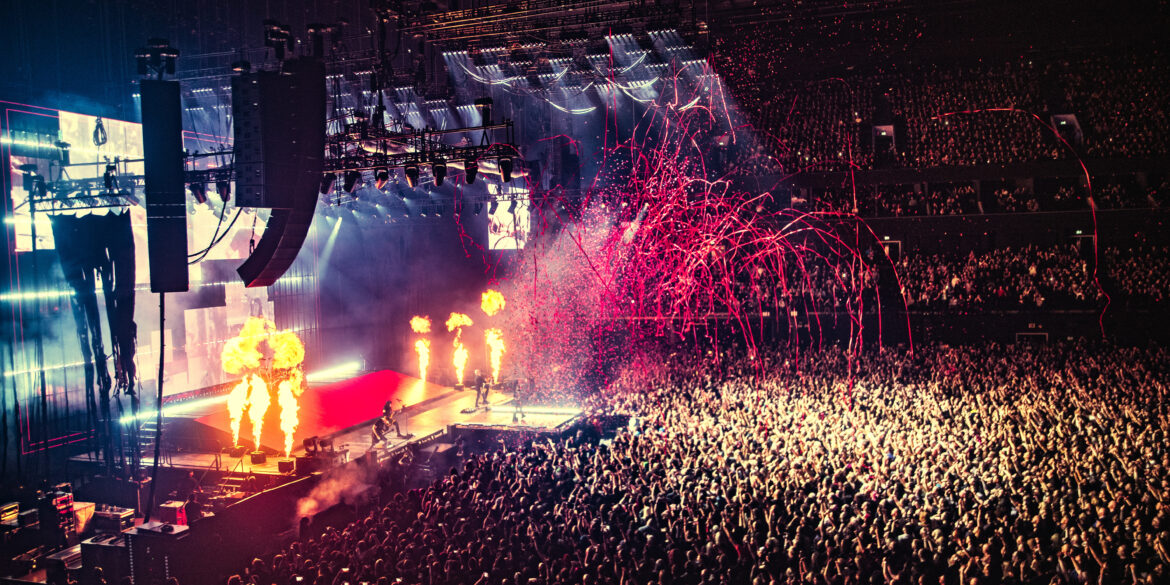
Walls of flame erupted from the front of the stage, enormous fireworks burst high above the stadium roof, and the entire production reached a breathtaking crescendo that somehow still managed to avoid feeling excessive. Instead, it felt earned.
Every emotional beat throughout the previous hour had been building towards this exact release.
Fire illuminated the band as thousands screamed every word back at them, while explosions of colour filled the night sky overhead. For several glorious minutes, it became almost impossible to know where to look. The stage itself resembled an inferno, fireworks framed Wembley above, and ninety thousand people collectively celebrated one of the defining anthems of modern rock.
It was magnificent.
As the song’s extended outro rang out, the fireworks gradually faded into drifting smoke while the band allowed every final note to linger just a little longer. It felt less like the conclusion of an album than the closing curtain of an extraordinary theatrical production.
Which, in many ways, it was.
The reprise of “The End” followed, bringing the narrative full circle with quiet elegance before “Blood” closed the performance in appropriately twisted fashion, complete with The Secretary appearing for the first time all night, as the final pieces of the story fell into place.
Then, unexpectedly, everything stopped.
The band disappeared.
The lights rose.
For around ten minutes, Wembley collectively caught its breath.
Most concerts would have reached their natural conclusion there.
Jane Driver-Loach – My Chemical Romance
The lights remained partially raised as technicians hurried across the enormous main stage, while conversations slowly returned around the stadium. There was an unmistakable feeling that we had just witnessed something complete. Had the evening ended there, I genuinely do not think many people would have left disappointed. The Black Parade had been performed in its entirety with a level of theatrical ambition that exceeded even the lofty expectations surrounding these Wembley shows. It had been less a concert than a fully realised stage production, meticulously crafted from beginning to end.
But My Chemical Romance were not finished.
Far from it.
Instead of returning to the towering main stage, attention suddenly shifted towards the much smaller B-stage positioned in the middle of the standing crowd. It had sat quietly in place all evening, almost forgotten amid the spectacle unfolding at the front of the stadium. Now, with the lights concentrating on its circular platform, its purpose finally became clear.
If the first half of the evening had belonged to The Black Parade, the second belonged to My Chemical Romance themselves.
The transition between the two performances was fascinating.
Gone were the elaborate theatrical sets, the carefully choreographed characters and the narrative that had guided the first hour. In their place stood five musicians, closer than ever to the audience, ready to celebrate the rest of a catalogue that has influenced alternative music for over two decades.
Clarice Jensen’s haunting “From A to B” provided an unexpectedly beautiful bridge between the two acts. Her cello performance gently reset the emotional landscape, washing away the grandeur of the theatrical production before allowing the band to emerge once again to deafening applause.
The intimacy was striking.
Despite standing inside a stadium containing ninety thousand people, the B-stage somehow shrank everything. Fans surrounded the platform from every direction, creating the illusion of a much smaller venue. Looking around, faces that had seemed impossibly distant throughout the first set suddenly felt close enough to recognise individual expressions.
It changed the atmosphere completely.
“Boy Division” exploded into life almost immediately, acting as a declaration that this second half would follow no rules other than celebration. Without the responsibility of progressing a narrative, the band looked visibly looser. Frank Iero bounded around the compact stage with infectious enthusiasm, Ray Toro grinned almost constantly while effortlessly tearing through every solo, and Mikey Way remained the ever-cool centre of the chaos.
Gerard, meanwhile, looked genuinely liberated.
There had been moments during The Black Parade where he was playing a role as much as performing songs. Here, that theatrical mask disappeared. His interactions became warmer, more spontaneous, and occasionally wonderfully chaotic in the way only My Chemical Romance can manage.
Then came one of the night’s biggest surprises.
“Party Poison”.
The roar that greeted its opening was immense.
The song had not been performed live since 2011, making its return feel genuinely momentous for longtime fans. Around me, people screamed in disbelief before the first verse had even begun, immediately recognising the significance of hearing one of the defining tracks from “Danger Days” resurrected after so many years.
Although I have always preferred My Chemical Romance’s earlier records, there was no denying the excitement surrounding its return.
The same could be said for much of the second set.
Rather than simply delivering a straightforward greatest hits collection, the band dipped confidently across every chapter of their career. It created a welcome sense of unpredictability, with each new song greeted by cheers from whichever section of the audience had formed the strongest attachment to that particular era.
“I’m Not Okay (I Promise)” was exactly as joyous as anyone could have hoped.
Nearly twenty-five years after its release, it remains impossible to hear that opening guitar without smiling. Wembley erupted instantly, the chorus becoming one enormous singalong as thousands gleefully shouted every sarcastic lyric back towards the stage. It was one of those moments where nostalgia stopped feeling retrospective and became something entirely present.
You could almost forget how many people surrounded you.
Then came perhaps the most unexpected emotional moment of the second set.
“Desert Song”.
Featuring Kayleigh Goldsworthy alongside Clarice Jensen’s stunning string arrangements, the song received a completely reimagined presentation that transformed it into something hauntingly beautiful. Its quiet vulnerability contrasted wonderfully with everything surrounding it, reminding everyone that beneath My Chemical Romance’s bombast has always existed remarkable emotional subtlety.
It was one of those performances where the entire stadium instinctively fell silent.
No dramatic production was required.
No explosions.
No fire.
Simply a beautiful song delivered with complete sincerity.
That emotional calm quickly gave way to “Na Na Na (Na Na Na Na Na Na Na Na Na)”, immediately throwing Wembley back into glorious chaos. If The Black Parade had represented My Chemical Romance at their most theatrical, Danger Days has always embodied their most colourful and rebellious instincts. Hearing those songs in such enormous surroundings proved just how underrated that era has gradually become.
I will admit, however, that this section of the set leaned slightly more heavily into Danger Days than I would personally have preferred.
Given the sheer depth of the band’s catalogue, there were perhaps one or two songs from Three Cheers for Sweet Revenge or The Black Parade that I might have swapped into their place.
That said, judging by the reactions around me, I was very much in the minority.
The crowd absolutely adored it.
Standing just a few feet away from me was one young woman who spent almost the entirety of the second set in tears. Not tears of sadness, but overwhelming joy. Every lyric seemed to carry years of personal meaning, every chorus another emotional release after what was clearly a deeply significant evening. Watching her react became almost as moving as watching the band themselves.
It served as a powerful reminder of what My Chemical Romance have always meant to people.
Few bands inspire this kind of devotion.
Their songs have become companions through grief, adolescence, loneliness and hope. Looking across Wembley, you could see countless similar stories unfolding simultaneously. Friends embraced during favourite songs. Parents sang alongside children who had discovered the band decades later than they had. Strangers exchanged smiles of recognition as beloved deep cuts emerged unexpectedly from the setlist.
It felt wonderfully communal.
“Vampires Will Never Hurt You”, dedicated to comic artist John Blanche, brought the evening crashing back towards the band’s earliest years. There was something immensely satisfying about hearing material from “I Brought You My Bullets, You Brought Me Your Love” performed in front of ninety thousand people. Those songs were written for tiny clubs and basement venues, yet somehow they retained every ounce of their urgency even beneath the vastness of Wembley Stadium.
“Vampire Money” followed with gleeful swagger, before “SING” arrived to perhaps the warmest audience response of any Danger Days track all evening.
If I had questioned the album’s prominence within the set beforehand, the reaction around me answered that criticism immediately.
Sometimes audiences tell you everything you need to know.
Then came “Helena”.
There are very few songs capable of uniting multiple generations of alternative music fans quite like it.
Dedicated to longtime producer Rich Costey, its opening notes immediately triggered one final emotional eruption across Wembley. Looking around during the chorus, almost every person in sight appeared to be singing. Some screamed the lyrics with joyful abandon. Others simply stood smiling through tears.
It remains one of the defining songs not only of My Chemical Romance’s career, but of an entire era of alternative music.
There could hardly have been a more fitting finale.
Except, of course, there was one final song.
“The Kids From Yesterday”.
Its placement at the very end of the evening felt quietly perfect.
The song has always carried a reflective quality, looking backwards without becoming trapped by nostalgia. As Gerard sang about growing older while refusing to let go of who we once were, the meaning felt almost painfully appropriate.
Around me, people who had grown up with this band stood beside teenagers discovering them for the first time. Twenty years had passed since My Chemical Romance first exploded into popular culture, yet here they were selling out Wembley Stadium for six consecutive nights while sounding every bit as vital as they ever had.
That achievement alone felt remarkable.
The song’s final chorus washed over the stadium one last time before gradually dissolving into applause that seemed determined never to end. The band stood together, waving quietly towards every corner of Wembley as ninety thousand people attempted to thank them all at once.
No extravagant speeches were needed.
No lengthy goodbyes.
The music had already said everything.
Walking back beneath the Wembley arch afterwards, surrounded by thousands of exhausted but euphoric fans, conversations seemed almost impossible to avoid. Everyone had their own favourite moment. Some spoke about “Welcome to the Black Parade”. Others could not stop discussing the theatrical production. One group excitedly debated hearing “Party Poison” live again after so many years. Everywhere you listened, people were trying to process what they had just experienced.
I found myself thinking about that distinction between the two halves of the evening.
The first had been theatre.
The second had been celebration.
Together, they formed something far greater than either could have achieved alone.
My Chemical Romance could easily have toured The Black Parade as a straightforward album playthrough. They could just as easily have relied upon a conventional greatest hits set to satisfy a stadium audience. Instead, they chose ambition. They trusted their audience to embrace storytelling, theatricality and emotional complexity before rewarding them with a joyous celebration of everything else that has made their career so extraordinary.
It was a gamble.
It paid off spectacularly.
Were there things I would have changed? Personally, I might have traded one or two Danger Days songs for earlier material, simply because those records resonate more deeply with me. But that feels like an incredibly minor observation within the context of a performance that achieved so much.
Because this was never simply about the setlist.
It was about what those songs represent.
Over the course of nearly three hours, My Chemical Romance reminded ninety thousand people why they remain one of the most important rock bands of the twenty-first century. Not because they have sold millions of records. Not because The Black Parade has become a classic. But because they understand something many bands eventually forget.
People do not build lifelong relationships with perfection.
They build them with honesty.
With emotion.
With songs that arrive exactly when they are needed most.
As I left Wembley, joining the endless river of black clothing disappearing into the London night, I realised I had stopped thinking about individual songs altogether. Instead, I kept returning to the overwhelming feeling the evening had left behind.
Some concerts entertain you.
Some amaze you.
Very, very few change the way you think about live music itself.
This was one of those rare nights.
Without question, it was one of the greatest concerts I have ever attended. Not simply because of its astonishing production or faultless performances, but because for one unforgettable evening My Chemical Romance transformed Wembley Stadium into something that felt impossibly intimate. They reminded ninety thousand people why these songs still matter, why The Black Parade continues to resonate almost two decades later, and why the connection between a band and its audience can sometimes become something far greater than music alone.
Long after the fireworks had faded, the costumes packed away, and the lights beneath the Wembley arch disappeared behind me, one thought remained impossible to shake.
Welcome to the Black Parade was never really an invitation into an album.
It was an invitation into a community.
On the 11th of July, ninety thousand people accepted it all over again.