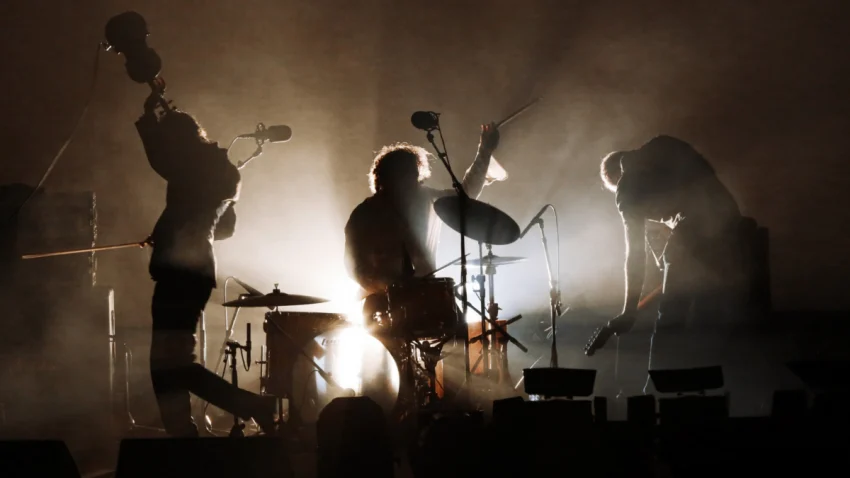

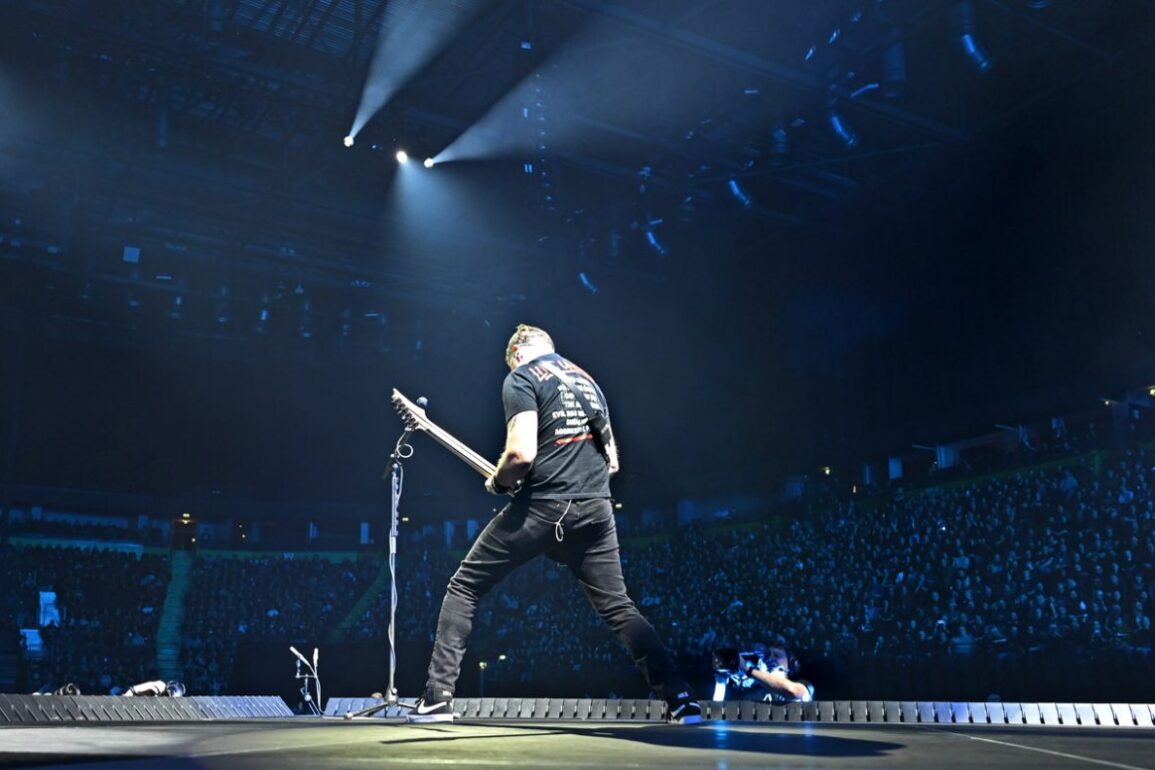
There are some nights that remind you why live music still feels magical in an era of endless streaming and short attention spans. When the lights dim, when the first chord echoes through a space full of people bound together by a shared love for something loud and human, the world seems to narrow down to that one, perfect moment. On the 8th of November at Manchester’s AO Arena, that magic was in no short supply. With Bush returning to the big stages and Volbeat bringing their unique mix of melodic metal, rockabilly swagger and arena-sized hooks, the night became a collision of veteran spirit and European showmanship that delivered far more than most anticipated.
To say I was impressed by Bush would be an understatement. The British band’s history is storied and uneven, a tale of early international success overshadowed at times by critical doubt, followed by quieter years that left them somewhat on the fringes of the mainstream. Seeing them back onstage before thousands of fans, commanding attention with such ease, felt entirely right. From the opening chords of Everything Zen, it was obvious that the years away had taken nothing from their potency. Gavin Rossdale remains one of the most magnetic frontmen of his era, mixing cool composure with pure, earned charisma.
That opening song’s grinding riff and philosophical sneer set the tone perfectly. The crowd were immediately drawn in, older fans mouthing every word, younger ones perhaps discovering the strength of Bush’s catalogue for the first time. Rossdale leant forward into the lights, hair slick under the glow, voice still carrying that perfect rasp that defined so much of their 90s success. His vocal tone has always balanced melody and grit with rare precision, and it filled the space beautifully.
By the time Bullet Holes arrived, the AO Arena was properly alive. The track has become an understated anthem of the band’s later years, fuelled by deceptively simple songwriting and thick, propulsive guitars. Rossdale’s bandmates locked in as though they had never left each other’s side. Every drummer’s strike snapped, every surge of distortion was measured to near perfection. The sound mix inside the arena was crisp, something not always guaranteed at an event of this scale.
Songs like Land of Milk and Honey showed just how comfortable Bush are on huge stages. They seem to thrive in the wide expanse, turning every movement into a moment. When a band can sink so effortlessly into their chemistry, that connection feeds into everything. At moments, Rossdale paced the stage like a man rediscovering something crucial about himself, occasionally jumping down to the barrier’s edge, clutching the mic and reaching toward fans who shouted his name. He looked at home in the lights in a way that made me wonder, genuinely, why this band are not far bigger today than they are. The songs look and feel built for places like this.
The biggest surprise of the set came with their cover of Come Together. It is obvious that taking on one of The Beatles’ most covered songs is a risk, especially in Manchester, where musical reverence can turn quickly into critique. But Bush pulled it off. They brought a darker, heavier edge to the track, slowing its pace and wrapping it in thick distortion. It was instantly recognisable but satisfyingly reimagined, grounding the melody in a more brooding atmosphere. The crowd swayed and sang with admiration rather than novelty.
Mid-set, Identity and I Am Here to Save Your Life pushed the energy higher still. There was a looseness, a sense of genuine enjoyment between bandmates. No element of the format felt slickly rehearsed. Instead, it thrived on instinct, a band reclaiming their identity through the act of performance. When More Than Machines hit, the entire floor moved as one, thousands of heads nodding in steady rhythm.
The moment that truly sealed the night for Bush came near the close with Swallowed. That opening melody line brought a wave of cheers long before Rossdale had reached the mic. Starting in near darkness, he let the first verse roll out almost solo, his voice curling through the air until the drums punched in and the room erupted. The song has aged astonishingly well, sounding every bit as emotionally sharp as it did when it first spun across alt-rock radio at the turn of the millennium.
They followed with I Beat Loneliness and Flowers on a Grave, the latter a stunning closer and reminder of their relevance in a modern landscape. Its chorus soared across the arena, a perfect mix of sentiment and strength. As the final notes rang out, Rossdale stood grinning, sweat-glossed and sincere, waving his thanks to a crowd who very clearly wanted more.
In truth, I left that portion of the night close to awestruck. Bush were not just a warm-up act; they were a reminder that timeless, instinctive rock music delivered with belief still resonates. There was no cynicism, no sense of nostalgia pandering. They simply played with heart, and it worked. Watching them, it became obvious that their absence from these kinds of stages in recent years is a shame. They should have been huge. And if nights like this one carry on, perhaps they still will be.
Trev Eales – Volbeat
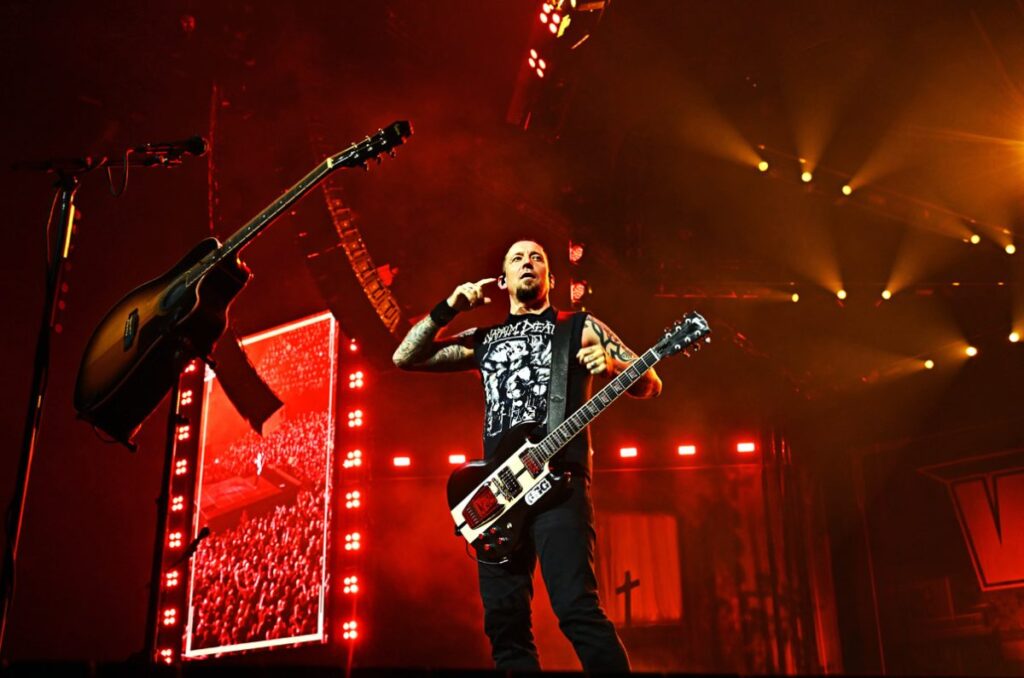
There are few modern bands as unmistakable as Volbeat. They sound like no one else, sitting comfortably at the crossroads of heavy metal, hard rock, rockabilly and blues, blending each into a swagger that feels both retro and distinctly their own. Across mainland Europe, they have spent years headlining stadiums and festivals, treated like royalty. In the UK, they occupy that fascinating middle ground between cult and mainstream, revered by dedicated fans but yet to hit quite the same heights they enjoy abroad. By the end of their set in Manchester, I could not help thinking that is more a reflection of geography than merit, because what unfolded inside the AO Arena that night was a masterclass in everything that makes them adored elsewhere.
The lights cut to pitch black. The sound of tension rang out, followed by the unmistakable opening riff of The Devil’s Bleeding Crown, its groove equal parts menace and sheer celebration. Instantly, the energy in the room shifted. There are very few bands that can ignite a crowd that fast, but the chemistry between Volbeat and their audience is automatic. Frontman Michael Poulsen exudes a kind of old-school charisma rarely seen now, part rockabilly crooner, part heavy metal preacher. He strutted across the stage with remarkable ease, leading both band and thousands of fans through the storm his band conjured.
Moving into Lola Montez and Sad Man’s Tongue, it became apparent that the set had been designed to please every section of the crowd. Longtime fans sang every word, new converts cheered in astonishment at how cohesive the sound was. The Ring of Fire intro woven into Sad Man’s Tongue drew grins all across the arena, a cheeky tribute to Johnny Cash that still managed to feel entirely Volbeat’s own. This blend of reverence and originality is exactly what makes them so captivating.
When they reached Demonic Depression and Fallen, the intensity deepened. The band walked a delicate line between melody and heaviness, one they handle with expert care. Every riff felt chunky and physical but never dense to the point of losing shape. Poulsen’s vocals, with that clean yet coarse tone, hit the sweet spot again and again, powerful but articulate enough to keep the crowd singing along.
One of the great strengths of Volbeat’s sound is its swing, that subtle rhythmic bounce beneath the distortion. You could sense it especially during Shotgun Blues and By a Monster’s Hand, tracks that moved with almost dance-like motion. The pit at the front was relentless, bodies pushing eagerly against one another, while in the seats, entire rows were standing, clapping along and shouting choruses. This was arena rock reimagined, less about slick perfection and more about shared release.
The band are master performers, but there’s something approachable in how they present themselves. Poulsen’s banter between songs was playful. He joked about the perpetual rain of Manchester and thanked everyone repeatedly for supporting them despite the long gaps between visits. The humility felt genuine, perhaps a reflection of that strange imbalance between their massive status elsewhere and their still-growing fan base here. Whatever the reason, the audience took it as an invitation rather than an apology, rewarding him with deafening cheers after every song.
Mid-set, Heaven nor Hell brought a communal lift; its rolling rhythm carried by the crowd in waves. Hands raised, flashes from phones and cameras dotting the darkness, and the energy just kept building. The emotional centre of the show arrived with The Devil Rages On and Die to Live, both thunderous and soulful in equal measure. For a band capable of volume that could rattle concrete, Volbeat have an impressive grasp of dynamic control. They know when to pull back, when to let melody breathe through the aggression.
An unexpected highlight came in the form of the absurdly titled In the Barn of the Goat Giving Birth to Satan’s Spawn in a Dying World of Doom, which sounded even more ferocious than its name suggested. It was fast, technically intricate, and carried that gleeful sense of theatricality that defines the band. The performance reasserted their identity beyond any genre tag. They are storytellers as much as musicians, crafting sonic pulp fiction rooted in passion and humour.
Later, Time Will Heal, and Black Rose gave the set a feast of melody, while Seal the Deal offered one of the night’s biggest sing-alongs. It is one of those songs built for spaces exactly like this one, sharp hooks wrapped in molten guitar tones. There was almost a spiritual intensity in the way people responded, arms rising instinctively as though pulled upward by the momentum of sound.
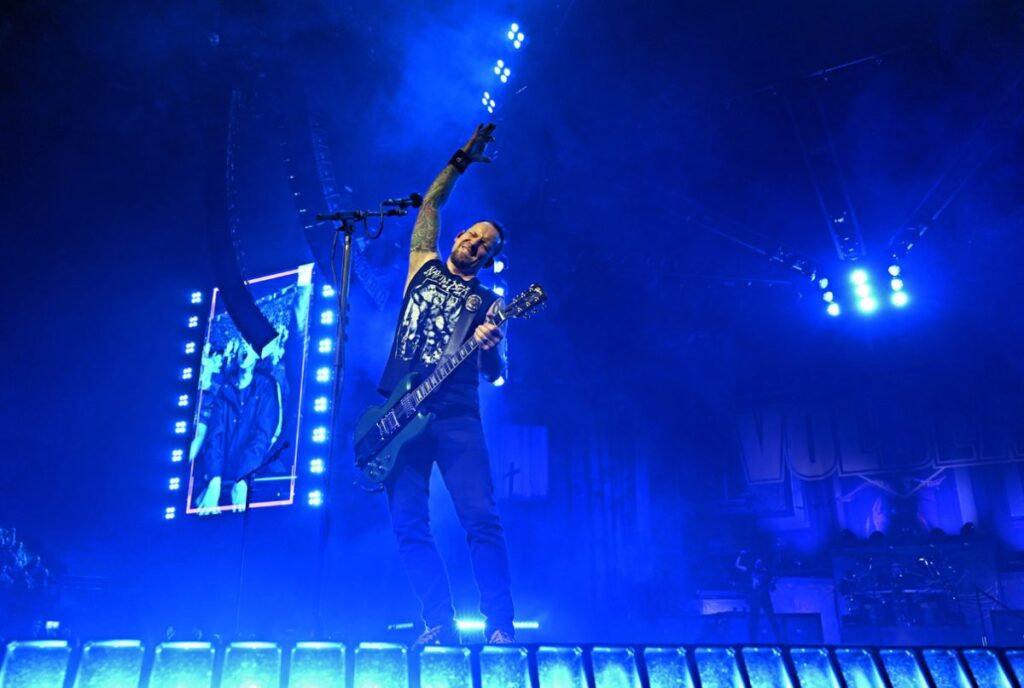
Trev Eales – Volbeat
When For Evigt rang out, the entire atmosphere turned euphoric. The blend of English and Danish lyrics carried perfectly, Poulsen’s voice strong and resonant, soaring across thousands of people unified in sound. It is rare to see that balance between precision and emotion sustain for an entire set, yet Volbeat managed it right to the end.
The final stretch of the night kicked into overdrive. The opening riff of Still Counting hit and the place erupted, the song’s rhythm as instantly recognisable as anything in modern rock. The chant of the chorus rolled like thunder around the arena, feeding back to the band in a loop of energy that built constantly until the last chord fell away.
But of course, they were not finished. The opening refrain of A Warrior’s Call arrived to an explosion of lights and sound. Poulsen roared the trademark intro, “Fight! Fight! Fight!” and every person in the building screamed it right back with pure joy. It was primal, jubilant chaos. The medley, closing with Pool of Booze, Booze, Booza, turned that energy into celebratory madness. Beer cups flew, voices cracked, and by the final roar of guitar feedback, it felt like every molecule of air had been charged.
Leaving the AO Arena that night, the simplest feeling was exhilaration. Bush had reminded everyone what a criminally underrated live force they have always been, while Volbeat proved beyond doubt why they command such loyalty at the very top of the European rock hierarchy.
Volbeat’s blend of old-school metal and melodic swing might not yet have penetrated the British mainstream in the way it has Germany or Scandinavia, but shows like this one chip away at that difference. Their sound is ready-made for arenas, and their hunger makes it impossible not to root for them.
The pairing of these two bands was inspired. Both carry decades of experience without any hint of fatigue. Both perform with sincerity and an understanding of what makes rock music so persistently powerful. For Bush, it felt like a glorious rebirth. For Volbeat, a reaffirmation of dominance. And for the audience, it was the kind of night that reignites everything good about being a fan of loud, unapologetic, heart-fuelled music.
As I stepped out into the cool Manchester night, ears ringing, the echo still followed me, the blend of melody and distortion humming deep inside the memory. Some gigs fade quickly. Others stay with you, replaying themselves long after the lights go out. This was one of the latter.